

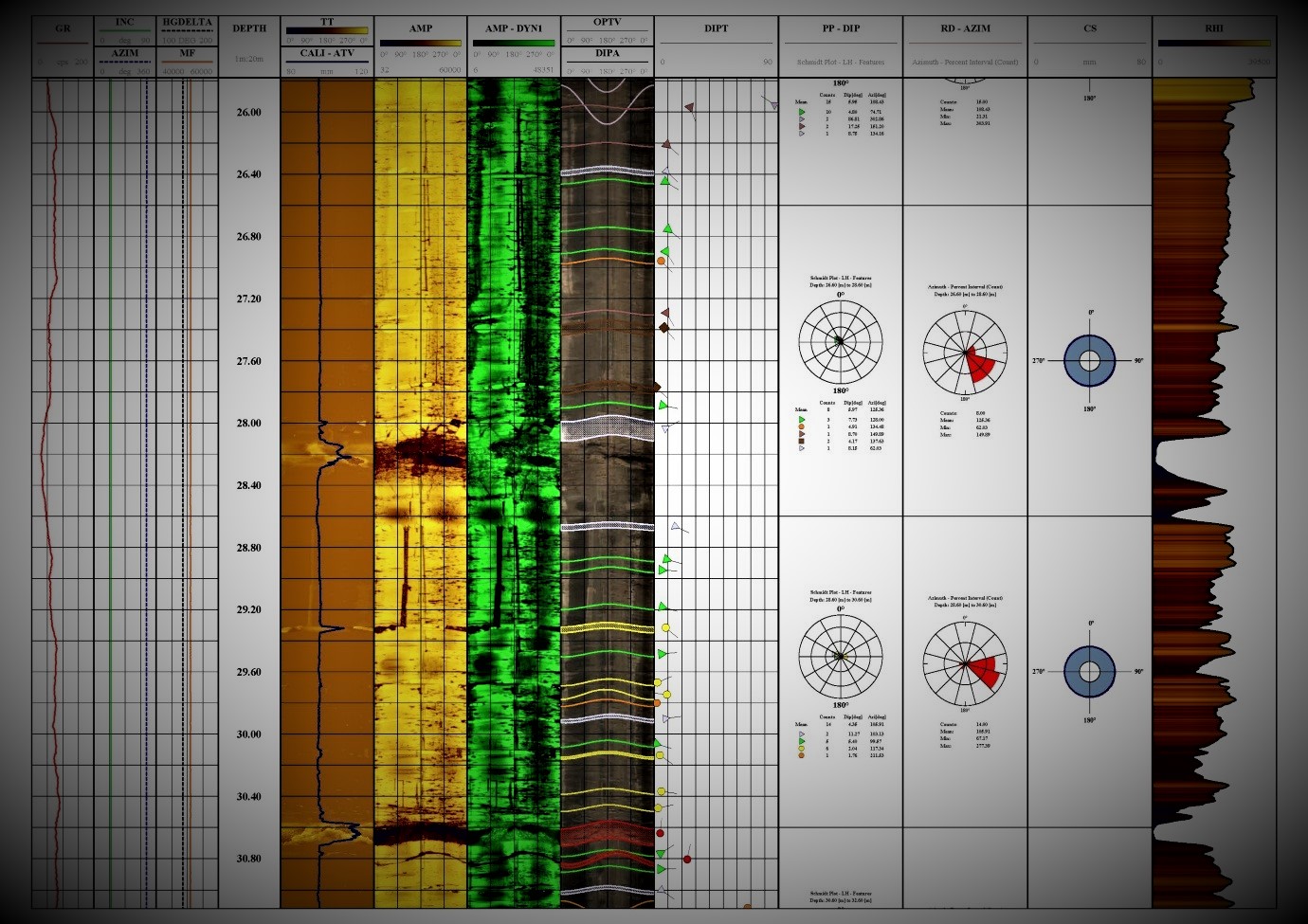
Sonic log measures the travel time of the amplitude of the elastic wave through the formation.
This information can be used to derive the velocity of elastic waves through the formation.
Full wave sonic (FWS) additionally will provide the entire sonic waveform with amplitude and travel time.
FWS most common applications are:
- Mechanical properties: rock strength and elasticity (Poisson’s ratio, bulk modulus, Young modulus, shear modulus, uni axial compressive strength TLUCS™, indentation hardeness index – TLIHI™)
- Determination of porosity (together with the gama-gamma density and neutron tools).
- Location of poor or missing cement behind casing (cement bond log – CBL).
- Fracture and permeability indication in hard rock.
- Determination of fracture aperture and permeability index.
- Provides a record of “seismic” velocity and travel time throughout a borehole. This information can be used to calibrate a seismic data set / synthetic seismograms (tie it in to the measured values of seismic velocity). The tool works at a higher frequency than seismic waves, therefore one must be careful with the direct comparison and application of sonic log data with seismic data.
- Stratigraphic correlation.
- Identification of lithology.
- Facies recognition.
- Identification of compaction.
- Identification of over-pressures.
- Identification of source rocks.